The Prologue
The prologue of this year’s Absa Cape Epic took place in Tokai forest, part of Table Mountain National Park, which features the only piece of critically endangered Cape Flats Fynbos and is the largest nature reserve for Cape Flats Fynbos in the city of Cape Town. It is also unique in South Africa as having a comprehensive, well-documented and curated herbarium collection of plants that occurred here before urban sprawl obliterated Cape Flats Sand Fynbos. With as many plant species as the entire Aride Savanna of Northern Province and Botswana, and more IUCN Red List plant species than the provinces of Gauteng, Free State and North-West Province combined, the Tokai section of the Table Mountain National Park is extraordinary. Although managed by SANParks, the WESSA-affiliated Friends of Tokai Park has adopted the area and tackles issues such as alien hacking, baboon management, fynbos restoration and species surveys.
Tulbagh / Saronsberg
The Tulbagh valley, where Absa Cape Epic participants, crew and other enthusiasts were hosted for stages one to three, offers an abundance of diverse flora throughout the valley - with proteas, restio and buchu growing wild. The main vegetation type, adapted to the area’s long dry summers and winters, is Breede Shale Renosterveld and is considered to be vulnerable. This consists mainly of fynbos shrublands with scattered small trees which include the waboom (Protea Nitida), named for its wood used for felloes on wagon-wheels. Plants that are rare and endemic to the area include the protea Vexatorella Latebrosa and the vygies Lampranthus Tulbachensi and Oscularia Vernicolor.
Worcester
Worcester is now home to those on their Absa Cape Epic journey, and is known for the Karoo Desert National Botanic Garden. The 154 hectare garden cultivates and displays a wide variety of desert and semi-desert plants. The terrain surrounding Worcester consists mainly of Western Little Karoo Vegetation and the geology consists of shale and sandstone. The vegetation comprises low succulent shrublets and occasional taller shrubs that feature some interesting and rather imaginative common names such as wolftoon, beestebal, sosatieplakkie and gifnoors. Although the area is generally dry with very little rainfall, the abundance of pollinating bees, butterflies, beetles and sunbirds ensure a spectacular spring flower display from late July until September each year.
Elgin / Oak Valley
The Elgin area will play host for the remainder of the event (stages five and six), before riders complete their journey at the Lourensford Wine Estate. The Elgin Valley is famous for its fynbos vegetation and forms part of the Kogelberg Biosphere Reserve; the first UNESCO ratified Biosphere Reserve in Southern Africa. The Kogelberg Biosphere Reserve encompasses the entire coastal area from Gordon’s Bay to the Bot River estuary and inland to Grabouw and the Groenland Mountain. The Reserve is known as the heart of the Cape Floral Kingdom and is home to an incredible 1 650 different plant species, making it one of the world’s richest sites of plant diversity. In addition, numerous animals including the elusive cape leopard, antelope, birds (including the soaring black eagle), freshwater fish and smaller creatures occur in this region of natural splendour.
Lourenford Wine Estate, Somerset West
As with the last four years, the Lourensford Wine Estate will be the welcome sight for those who can boast that they are 2011 Absa Cape Epic finishers. The Lourensford farm used to be part of the huge Vergelegen farm, utilised by Willem Adriaan van der Stel up until he was sent back to Holland. In 1709 Vergelegen was subdivided and Lourensford came into being. The farm has been subdivided and combined several times throughout its history. Today it spans just under 4 000 hectares.
The main river running through the farm is the Lourens River and the entire river is a declared Protected Natural Environment – the only river to be declared as such in the country. The river originates in the Hottentots Holland mountain range and runs for 22km through several farms and urban areas, before it reaches the sea at the Strand. The Landdrost River, Akkerboom Kloof and Stellenbosch Kloof are all tributaries with all their water eventually joining the Lourens River. Several rare and endangered bird species have found a safe haven at the river, including the Red-Chested Fulfftail and Peregrine Falcons. Fish Eagles have also found a safe haven in the dams surrounding the area.
The highest peak surrounding the farm is Sneeukop at a height of 1 590m above sea level. This peak is covered in snow during the winter months. To the right of Sneeukop you find Landdrostkop at a height of 1 515m. The peak to the right of that with the towers on it is known as Hans se Kop. To the left of Sneeukop, you will find Pic-Sans-Nom above the Lourens River at a height of 1 162m. Sir Lowry’s Pass is 619m above sea level. During February and March 2009 the farm was devastated by runaway fires, originating from Stellenbosch. All the fynbos in the upper mountainous areas was destroyed, as well as the majority of the pine plantations. Fynbos is adapted to cope with fires, and the re-growth has been phenomenal.
Several species of proteas and ericas are found in the mountains, together with the reeds, which make up a varied fynbos community. The upper regions of the Lourens River boast a fine community of red disas. The farm also boasts with several indigenous forests along the river banks. The huge milkwood trees found in these forests are hundreds of years old. They are accompanied by hottentot cherry trees, cape holly trees, tree fuchsias, red elders and silky bark trees.
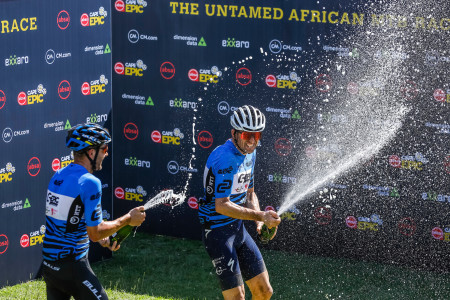
Karl Platt and Christoph Sauser win NTT Masters category in fine style